Site reputation abuse happens when a website hosts low-quality, third-party content primarily to exploit its own established ranking signals rather than to serve its audience. I’ve watched this policy reshape how publishers and SEOs think about partnerships, because Google now treats a site’s authority as something that can be misused, not just earned. This guide exists because the line between a legitimate content partnership and a violation isn’t always obvious until traffic disappears.
Getting this wrong costs real revenue and takes months to reverse. We built this resource because business owners deserve a clear diagnostic path, not vague warnings.
This guide covers what site reputation abuse actually is and how Google separates it from other manual actions, the third-party arrangements most likely to trigger a violation, how to diagnose and confirm a penalty, and the full recovery process along with realistic timelines and prevention steps.
What Is Site Reputation Abuse?
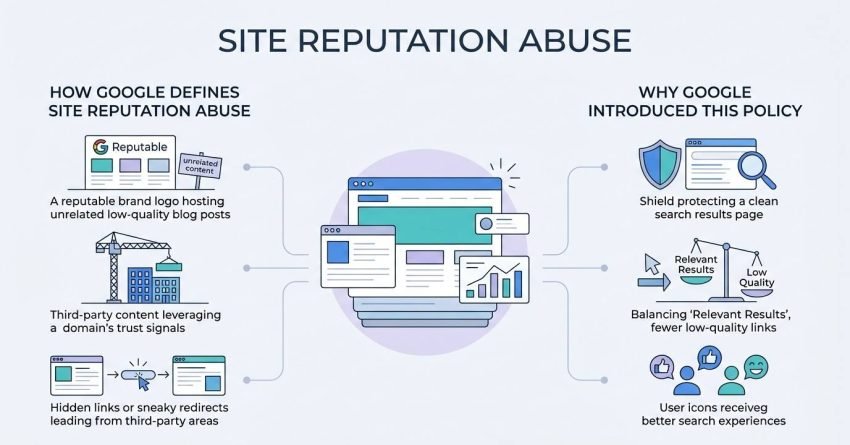
Site reputation abuse is a Google Search policy violation that occurs when a website publishes third-party content designed to exploit the host site’s ranking signals rather than to serve its own audience. Google formalized this policy in 2024 after noticing a growing pattern of established sites renting out subdirectories to unrelated third parties purely for SEO gain.
How Google Defines Site Reputation Abuse
Google’s own spam policies documentation describes this as content published “with little to no first-party involvement or oversight” from the hosting site. The defining signal isn’t the topic of the content. It’s the absence of editorial control and genuine business purpose.
A financial services blog that suddenly hosts a “best online casinos” section written entirely by an outside company shows the classic pattern. The host site gets no editorial say, and the third party gets a ranking boost it couldn’t earn on its own domain.
Why Google Introduced This Policy
Google introduced this policy because third-party content arrangements had become a widespread manipulation tactic, according to Google’s Search Central blog announcement from March 2024. Sites with strong domain authority were essentially renting that authority to unrelated advertisers and content mills.
This mattered to us because it changed how we vet every content partnership we recommend to clients. I now treat any proposed subdirectory or sponsored content deal as a potential liability until proven otherwise.
How Site Reputation Abuse Differs From Other Manual Actions
Site reputation abuse is distinct from pure spam and link spam because it targets the exploitation of an otherwise legitimate site’s authority rather than the creation of a spam site from scratch. Confusing these categories leads to the wrong recovery approach entirely.
Site Reputation Abuse vs. Pure Spam
Pure spam refers to sites built entirely around manipulating search results with little or no genuine value, and Google typically applies a sitewide manual action in these cases. Site reputation abuse, by contrast, usually affects a specific section of an otherwise legitimate, valuable website.
| Factor | Site Reputation Abuse | Pure Spam |
| Scope of penalty | Often subdirectory-specific | Usually sitewide |
| Host site quality | Genuine, established site | Low-value by design |
| Content origin | Third-party, outsourced | Automated or low-effort |
| Recovery focus | Remove violating section | Rebuild or abandon domain |
Site Reputation Abuse vs. Link Spam
Link spam manual actions target manipulative link schemes, while site reputation abuse targets manipulative content hosting arrangements. A site can receive both actions simultaneously if the third-party content also included unnatural links back to the partner’s other properties.
Common Third-Party Content Arrangements That Trigger Violations
Third-party content arrangements most commonly trigger site reputation abuse when a host site allows an external company to publish content in a dedicated subdirectory or subdomain with no editorial oversight from the host. The following list shows what shows up most often in real cases.
- Third-party coupon and deal pages hosted on retail or media sites with no product relationship
- White-label financial and loan content published on unrelated news or lifestyle domains
- Sponsored product reviews written entirely by an advertiser with no independent testing
- Casino and betting content hosted on general-interest or news publications
- Educational test-prep or degree content licensed to unrelated blogs
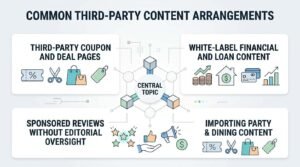
Third-Party Coupon and Deal Pages
Coupon and deal subdirectories became one of the most cited examples when Google enforced this policy in 2024, particularly against media publishers that licensed their domains to third-party coupon companies. The publisher gained short-term revenue while the coupon company gained ranking power it hadn’t earned.
White-Label Financial and Loan Content
White-label financial content involves a lender or financial services company producing articles that a higher-authority site publishes under its own domain without disclosing the arrangement clearly. This pattern draws scrutiny because financial content falls under Google’s Your Money or Your Life quality standards, raising the stakes for both parties.
Sponsored Reviews Without Editorial Oversight
Sponsored reviews cross into violation territory when the host site exercises no editorial judgment over claims, rankings, or recommendations written by the paying advertiser. Genuine sponsored content discloses the relationship and retains independent editorial review, which keeps it outside this policy’s scope.
Signs Your Site May Be Affected by Site Reputation Abuse
The clearest signs of site reputation abuse are a sudden, isolated traffic drop in one section of a site combined with a manual action notification in Google Search Console. These two signals together almost always confirm the issue rather than a broader algorithmic shift.
Sudden Traffic Drops on Specific Subdirectories
A traffic drop isolated to one subdirectory or subdomain, while the rest of the site’s organic traffic stays stable, points directly at a content-hosting problem rather than a sitewide algorithm update. I check Google Search Console’s Performance report filtered by URL path whenever a client reports this pattern.
Manual Action Notifications in Search Console
Google notifies site owners of a manual action directly inside Search Console under the Security & Manual Actions section, and this notification typically names “Site reputation abuse” explicitly as the violation type. This official label removes any guesswork about whether the drop is penalty-related or algorithmic.
How to Diagnose Site Reputation Abuse on Your Website
Diagnosing site reputation abuse starts with confirming whether Search Console shows a formal manual action, then auditing every subdirectory or subdomain for third-party content that lacks editorial oversight. This two-part process separates confirmed penalties from algorithmic ranking drops that need a different fix.
- Check the Manual Actions report in Google Search Console for a site reputation abuse notice
- Cross-reference the affected URL patterns named in the notice against your site’s content inventory
- Identify every third-party contributor, licensing deal, or outsourced content section on the flagged paths
- Review whether your team exercised genuine editorial control over that content
- Document publish dates and traffic history for the affected section using Google Analytics
- Compare the affected section’s backlink profile for any accompanying link spam signals

Auditing Subdirectories and Subdomains for Third-Party Content
A full audit means listing every subdirectory and subdomain on the domain, then asking who actually wrote and approved each section’s content. Sites accumulate these arrangements over years, so older partnerships often get missed during a first pass.
Using Search Console to Confirm Manual Actions
Search Console confirms a manual action by displaying the specific policy violated, the affected URLs where possible, and a timestamp for when the action was applied. This detail matters because it tells you exactly which section to prioritize instead of guessing across an entire domain.
The Business Impact of a Site Reputation Abuse Penalty
A site reputation abuse penalty typically removes the affected pages from search results entirely, cutting off organic traffic and any revenue tied to that section overnight. The scale of the loss depends on how much of the site’s total traffic that section represented.
Organic Traffic and Revenue Loss
Sites hit with this manual action often lose the entire organic visibility of the affected subdirectory within days of enforcement, according to case studies published by Search Engine Land following the March 2024 policy rollout. For publishers that relied on licensing deals for supplemental revenue, this loss can outweigh the fees they collected from the third party.
Long-Term Brand Trust Damage
Beyond the immediate traffic loss, a public manual action can damage a brand’s credibility with readers and advertisers who learn the site hosted low-quality sponsored content. Rebuilding that trust takes longer than recovering the rankings themselves.
Step-by-Step Recovery Process for Site Reputation Abuse
Recovering from a site reputation abuse penalty requires removing or properly disavowing the violating content, then submitting a reconsideration request that documents the corrective action taken. Skipping either step usually results in a rejected request.
- Identify and list every URL affected by the third-party content arrangement
- Remove the violating content entirely, or noindex it if a full removal isn’t feasible
- Terminate or renegotiate the third-party contract to prevent recurrence
- Document the changes made with before-and-after evidence
- Submit a reconsideration request through Search Console explaining the corrective steps
- Monitor Search Console for Google’s response, which typically arrives within a few weeks
Removing or Noindexing Violating Content
Complete removal is the strongest signal to Google, but noindexing the affected URLs while formally severing the third-party arrangement can serve as an interim step when full removal isn’t immediately possible. Either approach needs to be paired with actually ending the underlying content relationship, not just hiding the pages.
Submitting a Reconsideration Request
A reconsideration request should explain what the violation was, what specific actions were taken to fix it, and what governance changes prevent it from happening again. Vague requests that don’t name the removed content or the terminated arrangement get rejected more often than detailed ones.
How Long Site Reputation Abuse Recovery Takes
Site reputation abuse recovery typically takes four to twelve weeks from the date a reconsideration request is submitted, though full ranking restoration can take longer depending on how much trust the affected section needs to rebuild. Google doesn’t publish a fixed timeline, which makes planning around cash flow important for affected businesses.
Factors That Influence Recovery Timelines
The scope of the violation, the completeness of the cleanup, and the quality of the reconsideration request documentation all influence how quickly Google responds. Sites that fully sever third-party arrangements and provide clear evidence tend to see faster resolutions than those that only partially remove the offending content.
Preventing Future Site Reputation Abuse Violations
Preventing site reputation abuse starts with vetting every proposed content partnership against Google’s editorial oversight standard before signing any agreement. A written content governance policy makes this vetting consistent across a growing organization rather than dependent on one person’s memory.
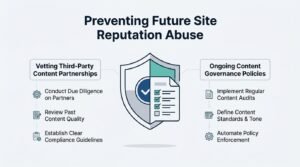
Vetting Third-Party Content Partnerships
Any proposed partnership should be evaluated for who retains editorial control, whether the content serves the site’s actual audience, and whether the arrangement would survive public scrutiny if named specifically. Licensing revenue that depends on hiding the arrangement’s true nature is a warning sign on its own.
Ongoing Content Governance Policies
A content governance policy formally assigns editorial review responsibility for every contributor type, including sponsored and licensed content, so no section of the site operates outside a review process. Larger sites with multiple content teams benefit most from documenting this in writing rather than relying on informal norms.
Site Reputation Abuse and Its Relationship to Parasite SEO
Site reputation abuse and parasite SEO describe closely related tactics, where parasite SEO refers to the practice of publishing content on a third-party high-authority platform specifically to borrow its ranking power. The distinction matters mainly in direction: parasite SEO is typically initiated by the content creator seeking a host, while site reputation abuse is enforced against the host site that allowed it.
Understanding this relationship helps site owners recognize inbound partnership pitches that follow the exact playbook Google now penalizes. A company offering to “pay for space” on a subdirectory is often running a parasite SEO strategy that will expose the host to this manual action.
When to Involve an SEO Professional for Recovery

Involving an SEO professional makes sense when the affected site lacks in-house Search Console expertise, when the violation spans multiple subdirectories, or when a previous reconsideration request has already been rejected. Recovery cases that involve legal contracts with third-party partners also benefit from outside coordination between SEO and legal teams.
An experienced SEO team can also help distinguish a genuine site reputation abuse penalty from an unrelated algorithmic drop, which changes the entire response strategy. Getting this diagnosis wrong wastes weeks pursuing the wrong fix.
Conclusion
Site reputation abuse penalizes third-party content that exploits a site’s authority without genuine editorial oversight. Diagnosis, removal, and reconsideration together form the recovery path, while governance policies prevent recurrence.
This issue connects closely to broader content governance and parasite SEO practices across the wider search landscape. Staying alert to partnership risks protects long-term organic visibility.
We help businesses diagnose, recover from, and prevent search penalties like this one. Contact White Label SEO Service to protect your organic growth today.
Frequently Asked Questions
What counts as site reputation abuse under Google’s policy?
Site reputation abuse is third-party content published on a host site primarily to exploit that site’s ranking signals. It typically involves little to no editorial oversight from the host.
How do I know if my site has a site reputation abuse penalty?
Check Google Search Console’s Manual Actions report for an explicit “Site reputation abuse” notice. A sudden traffic drop limited to one subdirectory is a common accompanying signal.
Can site reputation abuse hurt my site without a manual action?
Yes, algorithmic demotions related to this policy can reduce visibility without a formal manual action appearing. Reviewing third-party content quality proactively helps catch this before a notice arrives.
How long does it take to recover from a site reputation abuse penalty?
Recovery typically takes four to twelve weeks after submitting a reconsideration request. Full ranking restoration can take longer depending on the violation’s scope.
Does removing third-party content guarantee recovery?
No, removal alone doesn’t guarantee recovery since Google also reviews the reconsideration request documentation. Terminating the underlying arrangement and documenting the fix both matter.
Is affiliate content always considered site reputation abuse?
No, affiliate content is not automatically a violation when the host site maintains editorial control and genuine value. The policy targets outsourced content with no oversight, not affiliate relationships generally.
How can I prevent site reputation abuse in the future?
Vet every content partnership against Google’s editorial oversight standard before agreeing to it. A written content governance policy keeps this consistent across teams.