A Google core update is a broad, sitewide change to Google’s ranking algorithms designed to improve how well search results match user intent, and it can lift or drop thousands of sites’ rankings overnight. I’ve watched clients wake up to 40% traffic swings with zero warning. This isn’t a penalty. It’s Google re-evaluating whether your content still deserves its position.
Core update recovery usually takes patience, not panic. The businesses that recover fastest treat the drop as a diagnostic signal, not a crisis to fix in 48 hours.
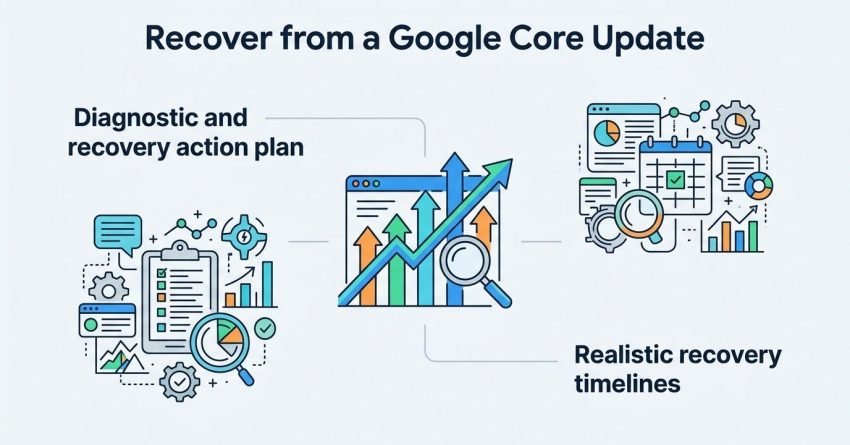
This guide covers how to confirm a core update actually hit you, the ranking factors most likely responsible, how to build a diagnostic and recovery action plan, realistic recovery timelines, and the mistakes that quietly slow recovery down.
What Is a Google Core Update?
A Google core update is a significant, sitewide revision to Google’s core ranking systems that reassesses content relevance, quality, and trustworthiness across the entire index. Google rolls these out several times a year, and unlike targeted algorithm tweaks, a core update can shift rankings for pages that never violated any guideline.
I think of core updates as Google recalibrating its scale, not punishing individual pages. The pages that move are being re-measured against a slightly different definition of “best answer.”
Google’s own search algorithm documentation confirms core updates don’t target specific sites, links, or content types. They adjust how multiple systems weigh signals together across the whole index.
How Core Updates Differ from Minor Algorithm Tweaks
Minor algorithm tweaks are narrow adjustments, often unannounced, that affect a specific ranking signal like spam detection or local pack results. Core updates are broader and reassess overall content quality and relevance at scale.
I’ve seen sites recover from minor tweaks within days. Core update losses behave differently and often persist until the next core update cycle confirms whether the reassessment sticks.
How Often Does Google Roll Out Core Updates
Google typically rolls out three to five confirmed core updates per year, though unconfirmed smaller adjustments happen continuously. Google’s Search Status Dashboard lists every confirmed rollout with start and end dates.
I track every rollout date against my clients’ analytics. That timestamp becomes the anchor point for every diagnostic conversation that follows.
How Do You Know a Core Update Hit Your Site?
A core update hit is confirmed when a sitewide traffic or ranking drop aligns precisely with a documented rollout date rather than a technical error or manual action. I always start here before touching anything else on a site.
Coincidence is common in SEO. A ranking drop during a core update window doesn’t automatically mean the update caused it.
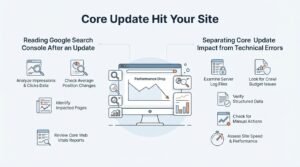
Reading Google Search Console After an Update
Google Search Console’s Performance report shows the exact date impressions and clicks began declining, which you can cross-reference against confirmed rollout dates. I pull the Search Console date range tool and overlay it against Google’s rollout calendar every single time.
A drop that starts exactly on day one of a confirmed rollout is a strong signal. A gradual decline over months usually points to something else entirely.
Separating Core Update Impact from Technical Errors
Technical errors like broken redirects, noindex tags, or server outages can mimic core update symptoms but require completely different fixes. Crawlability and indexation health issues need immediate technical remediation, not content strategy changes.
I check server logs and crawl stats before assuming an algorithm caused the drop. Ruling out technical failure first saves weeks of chasing the wrong fix.
Why Did Your Rankings Drop? Core Update Ranking Factors
Core update ranking losses typically trace back to three factors: content quality misalignment, search intent shifts, and weakened site-wide trust signals. Google rarely drops rankings for one isolated reason.
I’ve audited dozens of affected sites, and it’s almost always a combination, not a single smoking gun.
Content Quality Signals and E-E-A-T Signals
E-E-A-T stands for Experience, Expertise, Authoritativeness, and Trustworthiness, and it’s the framework Google’s human quality raters use to judge whether content deserves to rank. Google’s Search Quality Rater Guidelines explicitly define these four pillars as core to page quality assessment.
Content that reads as generic, unverified, or written without direct experience tends to lose ground first. I look for thin author bios, missing citations, and copy that could’ve been written about any topic without changing a word.
Search Intent Realignment
Search intent realignment happens when Google decides a different content format, angle, or depth better satisfies a query than what currently ranks. A page can be technically excellent and still lose rankings if the intent match shifted.
I’ve seen listicles get replaced by long-form guides overnight, and comparison pages outrank single-product reviews after intent shifted toward research-stage queries.
Site-Wide Authority and Trust Signals
Site-wide authority signals include backlink profile quality, domain history, and consistency of expertise across the entire site, not just the affected page. A core update can penalize an otherwise strong page if the rest of the domain signals lower trust.
I evaluate the whole domain’s backlink profile and authority signals whenever a single page underperforms unexpectedly, because the cause often sits outside that one URL.
The First 7 Days After a Core Update: What to Do (and Not Do)
The first seven days after a confirmed core update call for data collection and diagnosis, not immediate content or technical changes. Reactive changes made before diagnosis often target the wrong problem entirely.
I tell every client the same thing in week one: document everything, change nothing yet.
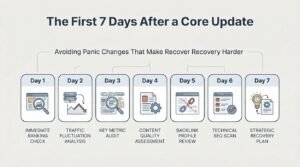
Avoiding Panic Changes That Make Recovery Harder
Panic changes like mass content deletion, rapid link removal, or wholesale redesigns can compound ranking losses by introducing new signals for Google to reassess. Making multiple simultaneous changes also makes it impossible to know what worked.
I’ve inherited accounts where three different “fixes” got layered on top of each other within a week, and untangling which change hurt versus helped took months longer than a slower, sequential approach would have.
How to Diagnose a Core Update Hit (Step-by-Step Audit)
Diagnosing a core update hit requires comparing what changed in the search results with what stayed constant on your own site during the same window. This comparison reveals whether Google’s standards shifted or your content simply fell short of a standard that always existed.
I run this audit the same way every time, because skipping steps means missing the real cause.
Comparing Winners and Losers in Your Niche
Identifying which competitors gained rankings during the same update reveals what Google now rewards in your specific niche. A study of core update volatility by SEMrush found that sites with clearer topical authority structures consistently outperformed thinner competitors across multiple update cycles.
I pull the top 10 results for my client’s target queries before and after the rollout date, then study exactly what the gainers have that the losers don’t.
Using Search Console Data to Pinpoint Affected Pages
Search Console’s Pages and Queries reports, filtered to the rollout date range, show exactly which URLs lost impressions and which queries dropped hardest. This data-first approach prevents guessing which pages need attention.
I export this data into a spreadsheet and rank affected pages by lost click volume, because that ordering tells me where recovery effort pays off fastest.
Content Quality Recovery: Aligning with Google’s Quality Rater Guidelines
Content quality recovery means rewriting or restructuring pages to demonstrate genuine experience, cite credible sources, and fully satisfy the query rather than superficially matching keywords. This is usually the single highest-leverage recovery lever available.
I treat this stage as a rebuild, not a touch-up, on any page that lost significant traffic.
Auditing Content Against E-E-A-T
An E-E-A-T content audit checks for author credentials, original data or insight, outbound citations to credible sources, and depth that matches or exceeds top-ranking competitors. Pages missing all four elements are the ones that dropped hardest in most core updates.
I score every affected page against this checklist and prioritize rewrites on pages scoring lowest first.
Content Pruning and Consolidation
Content pruning removes or merges thin, outdated, or duplicate pages that dilute a site’s overall quality signal across the domain. Ahrefs’ analysis of content pruning found that removing low-value pages improved organic traffic for a meaningful share of the sites studied within three months.
I consolidate near-duplicate pages into one comprehensive resource whenever a client’s site has multiple thin pages competing for the same query.
Technical SEO Factors That Influence Core Update Recovery
Technical SEO factors like site speed, mobile usability, and crawl efficiency don’t cause core update drops directly but can prevent recovery even after content improves. Google needs to crawl and render your fixes before it can reward them.
I always run a full technical audit alongside content work, because one blocked resource can stall recovery for months.
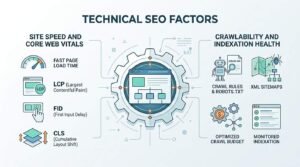
Site Speed and Core Web Vitals
Core Web Vitals measure loading performance, interactivity, and visual stability, and they factor into Google’s page experience signals. Google’s Core Web Vitals report in Search Console flags specific URLs failing these thresholds.
I check this report early, since a slow page can undercut even the strongest content rewrite.
Crawlability and Indexation Health
Crawlability issues, including blocked resources, broken internal links, and orphaned pages, prevent Google from properly re-evaluating updated content. Indexation health directly determines whether your recovery work even gets seen.
I audit the XML sitemap and crawl stats report for every recovering site, because I’ve found indexation gaps on pages the client assumed were fine.
Search Intent Mismatch: A Hidden Cause of Ranking Loss
Search intent mismatch occurs when the format, depth, or angle of a page no longer matches what searchers and Google expect for a given query, even if the content itself is accurate and well-written. This is one of the most overlooked causes of core update losses.
I compare my client’s page format against the top five ranking pages for the same query, checking whether they’re solving the query as a list, a guide, a tool, or a comparison, because a format mismatch alone can explain a ranking drop that content quality never fully accounts for.
Backlink Profile and Authority Signals in Recovery
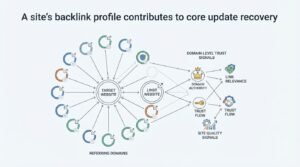
A site’s backlink profile contributes to core update recovery by reinforcing the domain-level trust signals that quality content alone can’t fully establish. Weak, spammy, or irrelevant backlinks can hold back an otherwise well-optimized page.
I audit referring domains for relevance and authority whenever content and technical fixes haven’t produced movement, because sometimes the missing piece is off-page, not on-page.
How Long Does Google Core Update Recovery Take?
Google core update recovery typically takes anywhere from a few weeks to several months, and full recovery often doesn’t happen until the next confirmed core update reassesses the same signals. There’s no fixed timeline Google publishes for this.
I set client expectations around 60 to 120 days as a realistic recovery window for meaningful, sustained fixes.
Why Recovery Isn’t Always Tied to the Next Core Update
Google’s ranking systems reassess pages continuously between major core updates, meaning genuine quality improvements can regain rankings before the next confirmed rollout. Waiting passively for “the next update” is a common misconception.
I’ve seen clients regain rankings mid-cycle after strong content and technical fixes, well before the next confirmed core update even rolled out.
Building a Core Update Recovery Action Plan
A core update recovery action plan sequences fixes by impact and effort, starting with the highest-traffic affected pages and the most severe quality or technical gaps. Random, scattered fixes waste the recovery window.
I build this plan as a prioritized spreadsheet, never a vague to-do list, so progress stays measurable week over week.
Prioritizing Fixes by Impact and Effort
Prioritizing by impact and effort means tackling high-traffic pages with clear quality gaps first, then moving to lower-impact technical cleanup. This sequencing gets measurable wins showing up faster in Search Console data.
I rank every affected URL on a simple two-axis matrix, traffic lost against fix complexity, before assigning any work to my team.
Tracking Recovery Progress the Right Way
Tracking recovery progress correctly means monitoring Search Console impressions and average position weekly, rather than watching daily ranking fluctuations that create false signals. Daily rank checks during a recovery period usually cause more anxiety than insight.
I set clients up with a simple weekly Search Console export instead of a rank tracker refreshing every few hours, because that noise obscures the real trend line.
Common Core Update Recovery Mistakes to Avoid
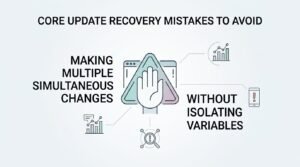
The most common core update recovery mistake is making multiple simultaneous changes without isolating variables, which makes it impossible to know what actually worked. Chasing every “recovery tactic” found online compounds this problem.
I’ve corrected accounts that deleted good content alongside bad, disavowed healthy backlinks out of panic, and rewrote pages that were never actually affected. Slower, isolated changes consistently outperform rushed, blanket ones.
How AI and Machine Learning Shape Core Update Algorithms
Machine learning systems like Google’s ranking models process quality and relevance signals at a scale no manual review process could match, and they underpin most modern core updates. This is why core updates feel less like rule changes and more like a shift in judgment.
I explain it to clients this way: Google isn’t checking a new box; it’s recalibrating a model trained on millions of quality judgments, which is why the “fixes” are qualitative, not mechanical.
When to Bring in an SEO Agency for Core Update Recovery
Bringing in an SEO agency makes sense when in-house teams lack the diagnostic tooling, historical benchmark data, or bandwidth to run a full recovery audit within a reasonable timeframe. Recovery work competes with everyday marketing tasks that rarely pause for a ranking drop.
I’ve watched internal teams lose months to trial-and-error fixes that a structured, data-backed audit would have resolved in weeks.
Conclusion
Recovering from a core update means aligning content quality, search intent, and site-wide trust signals rather than chasing quick fixes.
Every recovery strengthens your site’s foundation for the next algorithm shift, and the SEO landscape keeps rewarding genuine expertise over shortcuts.
We help businesses build data-backed recovery plans that restore rankings and long-term visibility. Partner with White Label SEO Service to get your traffic back on track.
Frequently Asked Questions
Does a Google core update mean my site was penalized?
No, a core update is not a penalty. It’s a broad reassessment of content quality and relevance, and rankings can shift for pages that never violated any guideline.
Can I recover from a core update without waiting for the next one?
Yes, Google’s systems reassess pages continuously between major updates. Genuine quality and technical improvements can regain rankings before the next confirmed rollout.
How do I know if a core update caused my traffic drop?
Compare your traffic decline date against Google’s confirmed rollout dates. A drop starting exactly on the rollout date strongly suggests the update caused it.
Should I disavow backlinks after a core update hit?
Not automatically. Disavowing healthy links during a panic response often does more harm than good. Audit link quality carefully before removing anything.
Will rewriting all my content fix a core update drop?
Not necessarily. Rewriting only helps pages with genuine quality or intent-mismatch issues. Blanket rewrites without diagnosis waste time and resources.
How often does Google release core updates?
Google typically releases three to five confirmed core updates per year. Smaller, unconfirmed adjustments happen continuously throughout the year.
Do technical SEO issues cause core update ranking drops?
Not directly, but technical issues like poor crawlability or slow Core Web Vitals can prevent recovery even after content improves. Google needs to crawl and reward fixes.