A single manual action or algorithmic update on an enterprise site can wipe out millions in organic revenue within days, and recovery demands a fundamentally different playbook than small-site SEO. I’ve watched teams try to apply blog-sized fixes to million-page domains and wonder why nothing moves. Scale changes everything about how a penalty happens and how it gets undone.
Enterprise recovery isn’t slower by accident. Cross-team approvals, templated architecture, and legacy technical debt all add friction that a five-page website never encounters.
This guide covers how penalties manifest differently at scale, the diagnostic process for isolating damage across huge site sections, how to build and sequence a recovery roadmap, and what realistic timelines and prevention actually look like once traffic starts coming back.
What Counts as an Enterprise-Scale SEO Penalty?
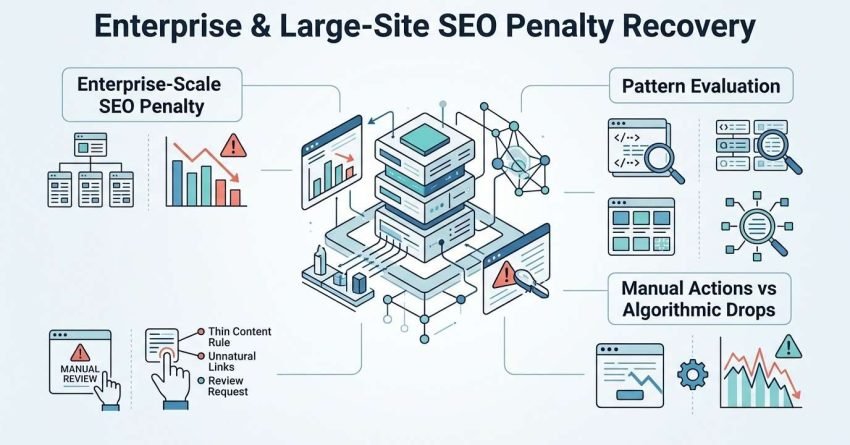
An enterprise-scale SEO penalty is a ranking or visibility loss that affects a site with tens of thousands to millions of indexed pages, where the cause typically originates in a template, pattern, or site-wide policy rather than a single page. I define it this way because the diagnostic approach changes entirely once a single template affects 50,000 pages instead of one.
Large sites get penalized differently than small sites because algorithmic systems evaluate patterns across the whole domain, not isolated pages. A thin content pattern repeated across product pages, for example, can trigger a broad quality signal that a single thin page never would.
Manual actions on enterprise sites often stem from acquired subdomains, legacy link schemes, or third-party content programs that predate current ownership. Algorithmic drops, by contrast, tend to hit templated sections all at once, which is itself a diagnostic clue.
Core Penalty Types Affecting Large Sites
Large websites face three dominant penalty categories, and each requires a distinct diagnostic and recovery path.
| Penalty Type | Typical Trigger at Scale | Recovery Path |
| Core algorithm update | Widespread thin/duplicate content patterns | Content quality remediation across templates |
| Manual action | Unnatural links, spam patterns, cloaking | Reconsideration request after cleanup |
| Site reputation/spam signal | Third-party content, acquired domains, UGC abuse | Isolation, disavow, or removal of offending sections |
Core algorithm updates rarely target one page. They re-evaluate entire sections against quality signals, which is why a broad update can crush an entire product category while leaving the rest of the domain untouched.
Manual actions, unlike algorithmic drops, arrive with an explicit notification in Google Search Console, naming the violation type and affected URLs. That specificity is actually an advantage at enterprise scale because it narrows the investigation immediately.
Site reputation issues show up most often after acquisitions, when a legacy forum, guest post program, or affiliate section carries spam signals into the parent domain.
How to Diagnose a Penalty on a Large Website
Diagnosing a penalty on a large website starts with segmenting traffic and rankings by URL pattern, template, or subdirectory to isolate exactly which section lost visibility and when. I never start with the homepage. I start with the segment that moved.
The diagnostic sequence looks like this:
- Pull organic traffic by directory or template in Google Analytics and Search Console
- Overlay the drop date against Google’s confirmed update timeline
- Check for a manual action notification inside Search Console
- Compare affected URLs against a content quality audit sample
- Cross-reference server logs for crawl behavior changes in the same window
- Rule out concurrent technical deployments that coincide with the drop
- Confirm whether the drop is domain-wide or isolated to specific templates
Reading Search Console at enterprise scale means filtering by URL path rather than reviewing the aggregate property view, since a property-wide graph hides section-specific damage inside a huge average.
Traffic segmentation is what separates a real diagnosis from a guess, because an enterprise domain can have five sections moving in five different directions at once.
The Unique Challenges of Recovery on Enterprise Sites
Enterprise SEO recovery is uniquely difficult because fixes must be implemented at the template level, where a single code change affects thousands of pages simultaneously instead of one. That leverage is powerful, but it also means mistakes scale identically.
Template-level issues require developer resources, QA cycles, and staging environments that a single-page fix never touches. A duplicate meta description pattern on 40,000 product pages isn’t fixed by editing one page.
Cross-team coordination becomes the real bottleneck at this scale. Engineering, content, legal, and brand teams all need to sign off before a template-wide change ships, and each approval layer adds days or weeks.
Auditing Crawl Budget and Technical Root Causes
Crawl budget is the number of pages a search engine is willing and able to crawl on a given site within a set period, and it becomes a critical constraint once a site exceeds a few hundred thousand URLs. I watch this metric closely on any domain above that threshold because wasted crawl budget delays recovery even after fixes ship.
Index bloat happens when low-value pages filtered URLs, thin tag pages, paginated duplicates consume crawl budget that should go toward money pages. A large ecommerce site can easily have ten times more indexed URLs than it has meaningful pages.
Duplicate content across templated pages is one of the most common root causes I find in enterprise audits, especially where product descriptions, location pages, or category filters generate near-identical content at massive scale.
Content Quality Issues That Trigger Penalties at Scale
Content quality problems at enterprise scale usually take the form of a repeated pattern across a template rather than a single weak page, which is exactly what broad core updates are built to detect. Thin, auto-generated, or lightly-spun content across thousands of URLs reads as a domain-wide quality signal.
Thin content patterns often emerge from database-driven pages, where a template pulls the same boilerplate copy with minor variable swaps across city, product, or category pages.
E-E-A-T gaps compound this problem. A study by Backlinko analyzing over 11,000 search results found that content depth and topical authority correlated strongly with top rankings, which matters enormously when thousands of pages share one shallow content template.
Link Profile Risks Unique to Large and Enterprise Domains
Enterprise domains carry link risks that smaller sites rarely encounter, primarily because of accumulated history, acquisitions, and legacy campaigns that predate current SEO oversight. A site that’s existed for fifteen years has fifteen years of link-building decisions attached to it.
Legacy link schemes surface most often after a company acquires another domain and inherits its backlink profile, including paid links, PBN placements, or reciprocal link networks built years earlier.
Disavow strategy at this scale requires pattern-based analysis rather than link-by-link review, since manually assessing hundreds of thousands of referring domains isn’t feasible within a normal recovery timeline.
Building an Enterprise Recovery Strategy and Roadmap
An enterprise recovery roadmap sequences fixes by potential impact and technical complexity, prioritizing changes that affect the most pages with the least engineering risk first. I build this as a scored matrix, not a simple to-do list.
Prioritization frameworks for thousands of pages typically score each issue on affected page count, estimated ranking impact, and implementation effort, then rank fixes by impact-to-effort ratio.
Sequencing matters because fixing content quality before resolving a technical crawl issue can waste the content investment if bots can’t reach the improved pages efficiently. I fix crawlability and indexation problems before content remediation in almost every case.
Reclaiming Content at Scale – Prune, Consolidate, or Rebuild
Content pruning removes or noindexes low-value pages that dilute a site’s overall quality signal, and it remains one of the fastest levers available in enterprise recovery. A Search Engine Journal analysis of large-scale pruning projects found meaningful ranking recovery within weeks of removing thin content clusters.
Pruning criteria for large libraries typically include: pages with zero organic traffic over 12 months, near-duplicate content scores above a set threshold, and pages with no internal or external links pointing to them.
Consolidation and redirect mapping combine overlapping pages into a single stronger resource, using 301 redirects to preserve any existing link equity rather than losing it outright.
Technical Remediation Workflows for Large Websites
Technical remediation on large websites follows a templated-fix-first workflow, where a single code or template change resolves an issue across every page sharing that template simultaneously. This is the core advantage of enterprise scale once a fix ships correctly.
Templated fixes handle systemic issues like duplicate title tags or missing schema markup across thousands of URLs in one deployment, while one-off fixes address isolated problems on individual high-value pages.
QA and staging protocols matter enormously here because a template error deployed to production can break thousands of pages simultaneously, turning a recovery effort into a new incident.
Stakeholder Management and Cross-Functional Execution
Enterprise SEO recovery depends as much on internal alignment as it does on technical accuracy, since engineering, content, legal, and brand teams all control pieces of the implementation. I’ve seen technically correct fixes sit unshipped for months over approval gridlock.
Aligning engineering, content, and legal teams requires a shared understanding of the penalty’s business impact, usually communicated through projected revenue loss rather than technical jargon that non-SEO stakeholders won’t act on urgently.
Timelines for Enterprise SEO Penalty Recovery
Enterprise SEO penalty recovery typically takes four to twelve months for algorithmic issues and two to six weeks for manual action reconsideration after remediation. These ranges assume fixes are implemented correctly and comprehensively across the affected templates.
Algorithmic recovery timelines depend on the next confirmed core update cycle, since Google has stated that sites affected by broad core updates generally need to wait for a subsequent update to see improvement.
Manual action reconsideration timelines move faster once a reconsideration request is submitted, with Google typically responding within a few weeks, though enterprise-scale cleanup before submission often takes longer than the review itself.
Measuring Recovery Progress and Performance Tracking
Recovery progress should be measured through leading indicators like crawl rate, indexation counts, and impression volume, which typically shift weeks before organic traffic itself recovers. Waiting for traffic alone to confirm progress means losing valuable diagnostic time.
Leading indicators before traffic returns include increased crawl frequency on remediated URLs, rising impressions in Search Console even without click growth, and improved average position on previously suppressed queries.
Segmented reporting for large site sections keeps stakeholders focused on the specific templates or directories under remediation, rather than an aggregate number that dilutes real progress happening in one section.
Preventing Future Penalties at Enterprise Scale
Preventing future penalties requires a governance framework that sets content and technical quality standards before pages publish, rather than auditing after damage occurs. I treat this as infrastructure, not a one-time cleanup.
Governance frameworks for content and technical standards typically include pre-publish content quality checklists, automated technical QA in the deployment pipeline, and scheduled quarterly audits of template-level patterns before they scale into problems.
Conclusion
Enterprise SEO penalty recovery hinges on template-level diagnosis, disciplined sequencing, and cross-team execution rather than page-by-page fixes. Algorithmic and manual penalties demand different timelines and different remediation paths entirely.
The broader SEO landscape keeps evolving, and large-site governance now determines whether future updates cause damage or pass by unnoticed. Prevention matters as much as recovery.
We help enterprise teams diagnose, prioritize, and execute recovery at scale. Talk to White Label SEO Service about building your recovery roadmap today.
Frequently Asked Questions
What is an SEO penalty recovery process for large websites?
SEO penalty recovery for large websites is a structured process of diagnosing which site section lost visibility, identifying the root cause, and remediating it at the template level. It requires cross-team coordination that smaller sites don’t need.
How long does it take to recover from a Google penalty on an enterprise site?
Enterprise recovery typically takes four to twelve months for algorithmic penalties and two to six weeks for manual action reconsideration. Timelines depend on remediation thoroughness and Google’s update cycle.
What is the difference between an algorithmic and a manual SEO penalty?
A manual penalty comes with explicit notification in Search Console naming the violation. An algorithmic penalty is a ranking drop from a broad system update with no direct notification.
How do you diagnose which section of a large site lost traffic?
Diagnosis starts by segmenting organic traffic and rankings by URL directory or template in Search Console and Analytics. This isolates exactly which section moved and when.
Can content pruning fix a penalty on a large website?
Content pruning can meaningfully help by removing thin or duplicate pages that dilute overall site quality signals. It’s often one of the fastest recovery levers available.
Why do enterprise sites take longer to recover than small sites?
Enterprise sites take longer because fixes require template-level changes, engineering resources, and multi-team approvals. A single-page fix on a small site has no equivalent bottleneck.
How do you prevent future penalties on a large website?
Prevention requires governance frameworks with pre-publish quality checklists and automated technical QA. Regular audits catch template-level issues before they scale into penalties.